Storing an image in MySQL sounds simple until the first upload contains the wrong MIME type, exceeds the server limit, or returns a broken image icon. The database is rarely the difficult part. Handling the file safely is where most of the work lives.
This tutorial builds a complete PHP 8.2+ example using MySQLi. It validates an uploaded image or PDF, stores the binary content and metadata in a MySQL BLOB, lists the saved files, and returns each file through a controlled PHP endpoint.
Quick answer
To store a file in a MySQL BLOB with PHP:
- Create a table containing a
BLOB,MEDIUMBLOB, orLONGBLOBcolumn. - Validate the upload error and file size in PHP.
- Detect the MIME type from the temporary file instead of trusting
$_FILES['type']. - Insert the binary data with a MySQLi prepared statement.
- Retrieve the BLOB by a validated numeric ID.
- Send the correct
Content-Type,Content-Length, andContent-Dispositionheaders before outputting the data.
The example uses send_long_data() to transfer the uploaded content to MySQL in chunks. It also stores the original filename, detected MIME type, file size, and a SHA-256 checksum.
Should files be stored in MySQL?
A BLOB is useful when the file must be stored, backed up, and controlled as part of the same database record. It can be a practical choice for small documents, private attachments, signatures, or images that require database-level access control.
For a large public image library, storing files in object storage or the filesystem and keeping only their paths in MySQL is usually more efficient. Large BLOB collections increase database size, backup time, memory use, and replication traffic.
This project limits each upload to 5 MB. That keeps the example practical while still showing the complete upload and retrieval flow.
Choose the appropriate BLOB type
| MySQL type | Maximum length |
|---|---|
TINYBLOB |
255 bytes |
BLOB |
65,535 bytes, about 64 KB |
MEDIUMBLOB |
16,777,215 bytes, about 16 MB |
LONGBLOB |
4,294,967,295 bytes, about 4 GB |
The project uses the LONGBLOB column type, but the application still enforces its own 5 MB limit. A large column capacity is not permission to accept unlimited uploads. PHP settings such as upload_max_filesize and post_max_size, along with MySQL’s max_allowed_packet, must also be large enough for the configured limit.
Create the MySQL table
The table stores the file content and the metadata required to return it correctly. Keeping the original name, MIME type, and size outside the BLOB also lets the gallery list files without loading their binary content.
CREATE DATABASE IF NOT EXISTS php_blob_demo
    CHARACTER SET utf8mb4
    COLLATE utf8mb4_unicode_ci;

USE php_blob_demo;

CREATE TABLE IF NOT EXISTS stored_files (
    id BIGINT UNSIGNED NOT NULL AUTO_INCREMENT,
    original_name VARCHAR(255) NOT NULL,
    mime_type VARCHAR(100) NOT NULL,
    file_size BIGINT UNSIGNED NOT NULL,
    sha256 CHAR(64) CHARACTER SET ascii COLLATE ascii_bin NOT NULL,
    file_data LONGBLOB NOT NULL,
    created_at TIMESTAMP NOT NULL DEFAULT CURRENT_TIMESTAMP,
    PRIMARY KEY (id),
    INDEX idx_stored_files_created_at (created_at)
) ENGINE=InnoDB;
The sha256 column is not required for displaying the file. This project uses it to verify that the retrieved BLOB still matches the uploaded content.
The application accepts only 5 MB per upload even though LONGBLOB supports much larger values. Keeping a separate application limit reduces memory pressure and makes failures easier to control.
Configure the upload rules
Place the size limit and MIME allowlist in config.php. A MIME allowlist is safer than trying to block a growing list of unwanted file types.
<?php

declare(strict_types=1);

const MAX_UPLOAD_BYTES = 5 * 1024 * 1024;

const ALLOWED_MIME_TYPES = [
    'image/jpeg' => 'JPEG image',
    'image/png' => 'PNG image',
    'image/gif' => 'GIF image',
    'image/webp' => 'WebP image',
    'application/pdf' => 'PDF document',
];
The keys are the MIME types accepted by the server. The application will detect the type from the uploaded file content. It will not trust the value supplied by the browser.
Connect to MySQL with MySQLi
The database connection is kept in db.php so the upload page and retrieval endpoint can use the same configuration.
<?php

declare(strict_types=1);

mysqli_report(MYSQLI_REPORT_ERROR | MYSQLI_REPORT_STRICT);

$database = new mysqli(
    getenv('DB_HOST') ?: '127.0.0.1',
    getenv('DB_USER') ?: 'root',
    getenv('DB_PASSWORD') ?: '',
    getenv('DB_NAME') ?: 'php_blob_demo',
    (int) (getenv('DB_PORT') ?: 3306)
);

$database->set_charset('utf8mb4');
Strict MySQLi error reporting converts database failures into exceptions. That makes it possible to log the technical error while displaying a safe message to the visitor.
The example reads credentials from environment variables and uses local development defaults when they are absent. On a production server, use a dedicated database account with only the permissions the application needs. Do not place a privileged MySQL password in a public project download.
Validate the uploaded file
The upload handler begins in index.php. It starts a session for the CSRF token, loads the configuration and database connection, and handles only POST requests.
<?php

declare(strict_types=1);

session_start();

require __DIR__ . '/config.php';
require __DIR__ . '/db.php';

if (!isset($_SESSION['csrf_token'])) {
    $_SESSION['csrf_token'] = bin2hex(random_bytes(32));
}

if ($_SERVER['REQUEST_METHOD'] === 'POST') {
    try {
        $token = (string) ($_POST['csrf_token'] ?? '');
        if (!hash_equals($_SESSION['csrf_token'], $token)) {
            throw new RuntimeException(
                'The form expired. Refresh the page and try again.'
            );
        }

        if (!isset($_FILES['upload']) || !is_array($_FILES['upload'])) {
            throw new RuntimeException('Choose a file to upload.');
        }

        $upload = $_FILES['upload'];
        $error = (int) ($upload['error'] ?? UPLOAD_ERR_NO_FILE);

        if ($error !== UPLOAD_ERR_OK) {
            $messages = [
                UPLOAD_ERR_INI_SIZE => 'The file exceeds the server upload limit.',
                UPLOAD_ERR_FORM_SIZE => 'The file exceeds the form upload limit.',
                UPLOAD_ERR_PARTIAL => 'The file was only partly uploaded.',
                UPLOAD_ERR_NO_FILE => 'Choose a file to upload.',
            ];

            throw new RuntimeException(
                $messages[$error] ?? 'The upload failed.'
            );
        }

        $temporaryPath = (string) ($upload['tmp_name'] ?? '');
        $size = (int) ($upload['size'] ?? 0);

        if (!is_uploaded_file($temporaryPath)) {
            throw new RuntimeException(
                'The uploaded file could not be verified.'
            );
        }

        if ($size < 1 || $size > MAX_UPLOAD_BYTES) {
            throw new RuntimeException(
                'The file must be between 1 byte and 5 MB.'
            );
        }

        $mimeType = (new finfo(FILEINFO_MIME_TYPE))
            ->file($temporaryPath);

        if (
            !is_string($mimeType)
            || !array_key_exists($mimeType, ALLOWED_MIME_TYPES)
        ) {
            throw new RuntimeException(
                'Upload a JPEG, PNG, GIF, WebP, or PDF file.'
            );
        }

        $originalName = str_replace(
            '\\',
            '/',
            (string) ($upload['name'] ?? 'upload')
        );
        $originalName = basename($originalName);
        $originalName = preg_replace(
            '/[\x00-\x1F\x7F]/u',
            '',
            $originalName
        ) ?? '';

        if ($originalName === '' || strlen($originalName) > 255) {
            throw new RuntimeException(
                'The file name is empty or longer than 255 bytes.'
            );
        }
The accept attribute on an HTML file input is useful for the visitor, but it is not a security check. A request can be created without the form, and the browser-provided $_FILES['upload']['type'] value can be inaccurate or manipulated.
finfo examines the temporary file and reports its MIME type. The result must still be compared with an explicit allowlist because detecting a type does not decide whether the application should accept it.
Insert the file into the BLOB column
After validation, calculate the checksum and prepare the insert. The BLOB parameter uses the MySQLi b type, and the send_long_data() method sends its content in 8 KB chunks.
        $checksum = hash_file('sha256', $temporaryPath);

        if ($checksum === false) {
            throw new RuntimeException(
                'The file checksum could not be calculated.'
            );
        }

        $statement = $database->prepare(
            'INSERT INTO stored_files (
                original_name,
                mime_type,
                file_size,
                sha256,
                file_data
             ) VALUES (?, ?, ?, ?, ?)'
        );

        $blob = null;
        $statement->bind_param(
            'ssisb',
            $originalName,
            $mimeType,
            $size,
            $checksum,
            $blob
        );

        $stream = fopen($temporaryPath, 'rb');

        if ($stream === false) {
            throw new RuntimeException(
                'The uploaded file could not be read.'
            );
        }

        try {
            while (!feof($stream)) {
                $chunk = fread($stream, 8192);

                if ($chunk === false) {
                    throw new RuntimeException(
                        'The uploaded file could not be read.'
                    );
                }

                if ($chunk !== '') {
                    $statement->send_long_data(4, $chunk);
                }
            }
        } finally {
            fclose($stream);
        }

        $statement->execute();

        $_SESSION['flash'] = [
            'type' => 'success',
            'text' => 'File uploaded successfully.',
        ];
    } catch (RuntimeException $exception) {
        $_SESSION['flash'] = [
            'type' => 'error',
            'text' => $exception->getMessage(),
        ];
    } catch (mysqli_sql_exception) {
        error_log('BLOB upload database error');

        $_SESSION['flash'] = [
            'type' => 'error',
            'text' => 'The file could not be saved.',
        ];
    }

    header('Location: index.php', true, 303);
    exit;
}
The fifth bound value has index 4 because send_long_data() numbers parameters from zero. This detail is easy to miss when the BLOB is not the first placeholder.
The redirect implements the Post/Redirect/Get pattern. Refreshing the result page will not submit the same file again, and the upload message survives for the redirected request through the session.
Create the upload form
After the upload handler, read and remove the flash message. Then query only the metadata needed by the gallery. The BLOB column is intentionally absent from this query.
$flash = $_SESSION['flash'] ?? null;
unset($_SESSION['flash']);

$files = $database->query(
    'SELECT id, original_name, mime_type, file_size, created_at
     FROM stored_files
     ORDER BY id DESC'
);

function escape(string $value): string
{
    return htmlspecialchars(
        $value,
        ENT_QUOTES | ENT_SUBSTITUTE,
        'UTF-8'
    );
}

function formatBytes(int $bytes): string
{
    return $bytes >= 1024 * 1024
        ? number_format($bytes / (1024 * 1024), 1) . ' MB'
        : number_format($bytes / 1024, 1) . ' KB';
}
Selecting file_data for the gallery would transfer every stored file from MySQL even though the page only needs names, types, sizes, and IDs. Fetch each BLOB separately when the browser requests it.
The upload form includes the session CSRF token and uses multipart/form-data, which is required for file uploads.
<section class="panel">
    <h1>Store files in a MySQL BLOB</h1>

    <p class="intro">
        Upload an image or PDF up to 5 MB.
        The file content and its metadata are stored in MySQL.
    </p>

    <?php if (is_array($flash)): ?>
        <div
            class="message <?= escape((string) $flash['type']) ?>"
            role="status"
        >
            <?= escape((string) $flash['text']) ?>
        </div>
    <?php endif; ?>

    <form method="post" enctype="multipart/form-data">
        <input
            type="hidden"
            name="csrf_token"
            value="<?= escape($_SESSION['csrf_token']) ?>"
        >

        <input
            type="hidden"
            name="MAX_FILE_SIZE"
            value="<?= MAX_UPLOAD_BYTES ?>"
        >

        <label for="upload">
            Choose a JPEG, PNG, GIF, WebP, or PDF
        </label>

        <input
            id="upload"
            name="upload"
            type="file"
            accept="image/jpeg,image/png,image/gif,image/webp,application/pdf"
            required
        >

        <button type="submit">Upload file</button>
    </form>
</section>
The hidden MAX_FILE_SIZE field may let PHP reject an oversized upload earlier, but a visitor can change or remove it. The server-side comparison with MAX_UPLOAD_BYTES remains the authoritative limit.
List the stored images and files
The gallery uses each database ID to build a URL for file.php. Images are loaded through that endpoint for previews. PDFs receive a simple document placeholder and are available as downloads.
<section class="panel">
<h2>Stored files</h2>
<?php if ($files->num_rows === 0): ?>
<p class="empty">No files have been uploaded yet.</p>
<?php else: ?>
<div class="file-grid">
<?php while ($file = $files->fetch_assoc()): ?>
<article class="file-card">
<?php if (
str_starts_with($file['mime_type'], 'image/')
): ?>
<a
class="preview"
href="file.php?id=<?= (int) $file['id'] ?>"
target="_blank"
rel="noopener"
>
<img
src="file.php?id=<?= (int) $file['id'] ?>"
alt="<?= escape($file['original_name']) ?>"
loading="lazy"
>
</a>
<?php else: ?>
<div class="document-icon" aria-hidden="true">
PDF
</div>
<?php endif; ?>
<h3>
<?= escape($file['original_name']) ?>
</h3>
<p>
<?= escape($file['mime_type']) ?>
·
<?= escape(
formatBytes((int) $file['file_size'])
) ?>
</p>
<a
class="download"
href="file.php?id=<?= (int) $file['id'] ?>&download=1"
>
Download
</a>
</article>
<?php endwhile; ?>
</div>
<?php endif; ?>
</section>Every filename and metadata value is escaped before it is inserted into HTML. A filename comes from the visitor, so it must be treated as untrusted text even after the file itself passes MIME validation.
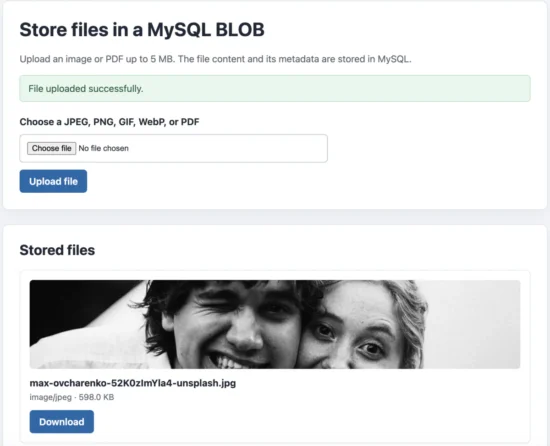
Files uploaded to and retrieved from a MySQL BLOB with PHP
Retrieve the BLOB with PHP
Create file.php to retrieve one record by its numeric ID. This endpoint returns only the binary response, so it must not print HTML, spaces, warnings, or debugging output before sending the headers.
<?php

declare(strict_types=1);

require __DIR__ . '/config.php';
require __DIR__ . '/db.php';

$id = filter_input(INPUT_GET, 'id', FILTER_VALIDATE_INT, [
    'options' => ['min_range' => 1],
]);

if (!is_int($id)) {
    http_response_code(400);
    exit('Invalid file ID.');
}

$statement = $database->prepare(
    'SELECT original_name, mime_type, file_size, sha256, file_data
     FROM stored_files
     WHERE id = ?'
);

$statement->bind_param('i', $id);
$statement->execute();

$file = $statement->get_result()->fetch_assoc();

if ($file === null) {
    http_response_code(404);
    exit('File not found.');
}

$data = $file['file_data'];

if (
    !is_string($data)
    || strlen($data) !== (int) $file['file_size']
    || !hash_equals($file['sha256'], hash('sha256', $data))
) {
    error_log(
        'Stored BLOB failed integrity verification for ID ' . $id
    );

    http_response_code(500);
    exit('The stored file failed its integrity check.');
}

$mimeType = array_key_exists(
    $file['mime_type'],
    ALLOWED_MIME_TYPES
)
    ? $file['mime_type']
    : 'application/octet-stream';

$download = isset($_GET['download'])
    || !str_starts_with($mimeType, 'image/');

$disposition = $download ? 'attachment' : 'inline';

$name = str_replace(
    ["\r", "\n"],
    '',
    $file['original_name']
);

$asciiName = preg_replace(
    '/[^A-Za-z0-9._-]/',
    '_',
    $name
) ?: 'download';

header('Content-Type: ' . $mimeType);
header('Content-Length: ' . strlen($data));

header(
    'Content-Disposition: '
    . $disposition
    . '; filename="'
    . $asciiName
    . '"; filename*=UTF-8\'\''
    . rawurlencode($name)
);

header('X-Content-Type-Options: nosniff');

header(
    "Content-Security-Policy: default-src 'none'; sandbox"
);

header('Cache-Control: private, no-store');

echo $data;
The validated integer ID and prepared statement prevent the URL parameter from becoming part of the SQL query. If no matching row exists, the endpoint returns a 404 Not Found response.
The checksum comparison provides an integrity check before any content is sent. If the stored bytes no longer match the SHA-256 value recorded during upload, the endpoint logs the record ID and returns an error instead of serving damaged content.
Display an image BLOB
An allowlisted image can use file.php
<img
    src="file.php?id=<?= (int) $file['id'] ?>"
    alt="<?= escape($file['original_name']) ?>"
>
When the request does not contain the download parameter, an image receives an inline content disposition. Its stored MIME type becomes the response Content-Type, allowing the browser to display the returned bytes.
Download a stored file
Add download=1
<a href="file.php?id=42&download=1">Download</a>PDF files are always returned as attachments in this example, even without that parameter. Only allowlisted image types may be displayed inline.
The ASCII filename fallback keeps the basic header safe and compatible. The additional filename* value preserves a UTF-8 filename for browsers that support it. Carriage returns and line feeds are removed before either value is used.
X-Content-Type-Options: nosniff tells the browser not to reinterpret the declared type. The restrictive Content Security Policy adds another boundary around inline responses, while Cache-Control: private, no-store avoids leaving uploaded files in shared caches.
Security considerations for BLOB uploads
Prepared statements protect the database query, but secure file handling needs several separate checks. No single validation step covers the entire upload and retrieval process.
- Validate the upload status. Check the PHP upload error before reading the temporary file.
- Set a server-side size limit. Do not rely on the HTML
MAX_FILE_SIZEvalue. - Detect the MIME type. Use Fileinfo instead of trusting
$_FILES['upload']['type']or the filename extension. - Use an allowlist. Accept only the file types the application is designed to handle.
- Protect the form from CSRF. A valid session token should be required for each upload request.
- Escape filenames in HTML. The original filename is visitor-controlled text.
- Control the response headers. Set the content type, disposition, length, caching policy, and
nosniffheader explicitly. - Add authorization when files are private. A hard-to-guess URL is not an access-control system.
Storing a file inside MySQL prevents the web server from executing it as a PHP script from an upload directory. That does not make every stored file safe. The application must still validate uploads and control how their content is returned.
The tutorial permits images and PDFs because the interface is built for those types. If the application only needs images, remove application/pdf from the allowlist instead of accepting it without a use case.
Common errors and fixes
The file exceeds the server upload limit
PHP may reject the request before the application can inspect the file. Check the PHP upload settings in the active php.ini:
upload_max_filesize = 6M
post_max_size = 7M
post_max_size must be larger than upload_max_filesize because the request also contains form boundaries and other fields. Restart the web server or PHP service after changing the configuration.
The MySQL server reports that the packet is too large
The uploaded BLOB and prepared statement must fit within MySQL’s max_allowed_packet limit. Inspect the current server value with:
SHOW VARIABLES LIKE 'max_allowed_packet';If it is smaller than the application’s maximum upload plus statement overhead, increase it in the MySQL server configuration. Do not increase the application limit simply because the BLOB column can hold more data.
The browser shows a broken image
Open the image URL directly and inspect its response. A PHP warning, HTML error page, incorrect MIME type, or output sent before header() will corrupt the binary response.
Keep file.php free of templates and debugging output. Log internal errors on the server instead of printing them into the file content.
The retrieved file is empty
Confirm that the upload size is greater than zero and that send_long_data() uses the correct parameter index. In this project, the BLOB is the fifth placeholder, so its zero-based index is 4.
Also verify that PHP can read the temporary upload before the request ends. The temporary file is removed automatically after PHP finishes handling the request.
Fileinfo is unavailable
The project requires PHP’s Fileinfo extension. Check whether it is enabled:
php -mLook for fileinfo in the output. If the command-line and web server PHP installations use different configuration files, confirm the extension in the web environment as well.
MySQLi cannot connect to the database
Confirm the host, port, database name, username, and password supplied through the environment variables. MySQL may treat localhost and 127.0.0.1 differently because one can use a Unix socket while the other uses TCP.
In production, log the database exception privately. Do not display credentials, SQL details, or server paths in the browser.
Run the complete project
Import schema.sql
mysql -u root -p < schema.sqlSet the database environment variables if the local defaults do not match your setup:
export DB_HOST=127.0.0.1
export DB_PORT=3306
export DB_NAME=php_blob_demo
export DB_USER=root
export DB_PASSWORD=your_password
Start PHP’s local development server from the same directory:
php -S 127.0.0.1:8000Open http://127.0.0.1:8000 and upload an allowlisted image or PDF. The page will save the file in MySQL and add it to the gallery.
The PHP development server is convenient for local testing. Use a properly configured web server with HTTPS for a public application.
Project structure
mysql-blob-using-php/
├── README.md
├── config.php
├── db.php
├── file.php
├── index.php
├── schema.sql
└── style.cssindex.phpvalidates uploads, inserts BLOB data, and displays the file gallery.file.phpretrieves a BLOB and returns it as an inline image or download.config.phpdefines the upload limit and MIME allowlist.db.phpcreates the MySQLi connection.schema.sqlcreates the database and table.style.cssprovides lightweight styling for the form, messages, and gallery.README.mdcontains setup and configuration instructions.
Developer FAQ
Should binary files be converted to Base64 before storing them?
No. A BLOB column stores binary data directly. Base64 increases the stored size and adds unnecessary encoding and decoding work. Send the original bytes through a prepared BLOB parameter.
Can the project store files other than images and PDFs?
Yes, but each additional type should have a real application use case. Add its verified MIME type to ALLOWED_MIME_TYPES and decide whether the retrieval endpoint should display it inline or force a download.
How can several files be uploaded at once?
Add the multiple attribute to the file input and use an array-style field name such as upload[]. PHP will then provide arrays inside $_FILES['upload']. Validate and insert every file independently, including its upload error, size, MIME type, and filename.
How do I update an existing BLOB?
Use the same validation and streaming process with an UPDATE statement:
UPDATE stored_files
SET original_name = ?,
    mime_type = ?,
    file_size = ?,
    sha256 = ?,
    file_data = ?
WHERE id = ?;
Validate the record ID and authorize the operation before replacing its content.
Why not include the BLOB in the gallery query?
A metadata page does not need every file’s binary content. Selecting only the ID, name, MIME type, size, and creation time keeps the initial query smaller. The browser requests an individual BLOB only when it loads a preview or follows a download link.
Is this project ready for private user files?
The upload and retrieval mechanics are secure starting points, but the tutorial does not include user accounts or file ownership. Add authentication and check that the current user may access the requested record before returning private content.
Download the PHP MySQL BLOB project
The complete PHP 8.2+ project includes the MySQL schema, MySQLi upload and retrieval code, MIME validation, checksum verification, light CSS, and setup instructions.



not working for me, where does if(isset($_GET[‘image_id’])) get set
Hi George,
image_id might be empty while requesting page
imageview.php?image_id=
Check the db if there is required blob entry.
in “Read Image BLOB to Display”
instead of showing the image there it self, I would like to just display the name of the file, and when clicked it has to be downloaded.
Please give steps for the same… :))
Store the original filename in a separate column. Then display it as a download link:
In file.php, retrieve the BLOB and send it with:
The project in this article already uses this download pattern.
Thanks for this tutorial
i have a different problem
my database consist blob record of pics and i want to transfer pics to a folder (specified by a field in table)
regards
manoj bisht
Fetch the BLOB and filename, then write it to the required folder:
Ensure the folder exists and is writable. Validate the folder path and filename before saving, especially if either value comes from user input.
thank you very mutch you help me to discover all of my default in my script… thank again :)
Welcome Oussama
Thanks very much for this info, it was just what I needed!
Welcome James
wow it’s work thanks
Welcome Betelhem
Dear, Vincy, thank you for your tutorial, it’s help me to improve my php programming skill, i hope we could discuss about php in this forum.
I have test the aplication with hijacked image file that contents php code, and it could not hijacked the web. This is the way that i hope by using the blob database than upload and save the file in a folder.
Bye the way,thank you and God bless you Vincy.
Your new friends from Indonesia,
Harry Witriyono
Hi Harry,
Thank you for your kind words. I am glad the tutorial helped you.
Storing an image as a BLOB prevents it from being executed directly from an upload folder. However, always validate its MIME type and size, and return it with safe response headers.
You are welcome to discuss PHP here anytime.
Regards,
Vincy
I’ve been searching for a couple days to find an example that shows how to update a longblob. If I use the exact same data to UPDATE in a MySQL statement, I don’t get any results. INSERT has been simple. UPDATE seems impossible.
Updating a LONGBLOB works like inserting one:
If the new data is identical to the existing BLOB, MySQL may report zero affected rows. That does not mean the query failed.
when i retriving image from database, it show me too many samples, what is the problem
I would like to add a 5 file fields undersame record is it possible?
Yes. Use one multiple-file input:
Store each file in a separate database row with the same parent record ID. Limit the upload to five files and validate each file separately. This is better than adding five BLOB columns to one row.
Yes. SQLite supports BLOB data through PDO. The upload validation stays the same; only the database connection and prepared statements change.
I will cover the PDO and SQLite version in a separate tutorial.
Sure Jishnu, I will write an article on PDO and Sqlite soon. Thanks.
How do I insert a video instead of an image?
A video can be stored in a `LONGBLOB` using the same process as an image. Add the required video MIME type to your allowlist:
To display the stored video, use:
The retrieval endpoint must return `Content-Type: video/mp4` and use an inline content disposition.
For production applications, storing large videos in the filesystem or object storage and saving only the path or URL in MySQL is usually more practical. Videos can make the database, backups, and retrieval requests very large. Video delivery should also support HTTP range requests so users can seek without downloading the whole file.
If you store the video as a BLOB, ensure the PHP upload limits and MySQL `max_allowed_packet` value are large enough.
Excellent article. Best of the best, thanks
Welcome Jessang
Thank You So much,
With some tweaks here and there I was able to complete my school assignment. This is the best tutorial I’ve ever seen for ‘Inserting Images in PHP’
Would definitely recommend it to others
Thank You Vincy ✌
Wow, thank you Mohammad.
Thank you very much! It worked like a clock.
Welcome Binchuncha.
Nice tutorial,
Good that you have focussed on security also.
Greets,
bstd
Thanks Bstd
Thanks a lot. I searched a lot and tried many ways to do this. I’m happy that I found this. Once again thank you so much.
Welcome Sreeja
very very good
thankyou very much.
Welcome Omid
I have been trying to do this for days and this didn’t even work D: I tried implementing this into my own php code, wow its working. thanks, thanks.
Welcome
I’ve been looking all over for this solution!!
Thank you so much!!
Welcome Adrian
Hi and thanks for sharing such great quality articles.
Welcome Joshua
Thank you for this!
Welcome Sarah
Hi Vincy, thanks for this great totorials. I Succesfully to upload and then display image in browser.
And then, how can i set the “$row[“imageData”]” as attachment through PHPMailer?
Since `$row[‘imageData’]` contains the image bytes rather than a file path, use PHPMailer’s `addStringAttachment()` method:
If your table also stores the original filename, you can use it instead of `image.jpg`:
Call this after creating the PHPMailer object and before `$mail->send()`.
Do not apply `base64_encode()` to the BLOB yourself. PHPMailer will encode the binary data for the email attachment.
I love your tutorials it’s awesome
Quick question
Can I also upload videos with this
And also can I use that blob data and do some editings to the video or image and it would still work
Thanks. Yes you can do. I have given details in a below comment.
Thank you Vincy. You are great!
Welcome Justin
Good secure code. Fantastic!
Thanks Kyle
Thank you very much!
Welcome Diana.
Can I use this tutorial as well when using Angular 12?
Hi Jürgen,
Sure you can use it but needs to be adapted to Angular.
Hello, I have tried this but did not succeed. Is there a tutorial of yours explaining how to do this with Angular?
Hi Jürgen,
Let me know what issue you are facing and I will try to help you out. I will try to write the same on Angular soon.
Hello, my problem is that I am not able to save an image (Blob or just the file path) in the database when I am using Angular. It works perfect when I am saving text (name, etc) in my SQL database in Angular. But I struggle to save an image.
Hello Jürgen,
Angular should not save the image directly to MySQL. Send the image to your PHP backend as `multipart/form-data`, then let PHP validate it and store either the file content or its path.
In Angular:
“`typescript
const formData = new FormData();
formData.append(‘name’, this.name);
formData.append(‘image’, this.selectedFile);
this.http.post(‘https://example.com/upload.php’, formData)
.subscribe(response => console.log(response));
“`
Do not set the `Content-Type` header manually. The browser will add the required multipart boundary.
In PHP, the uploaded image will be available in:
“`php
$_FILES[‘image’][‘tmp_name’]
“`
To store it as a BLOB:
“`php
$imageData = file_get_contents($_FILES[‘image’][‘tmp_name’]);
“`
To store only its path, first move it to an upload directory:
“`php
$path = ‘uploads/’ . basename($_FILES[‘image’][‘name’]);
move_uploaded_file($_FILES[‘image’][‘tmp_name’], $path);
“`
You can then insert `$imageData` or `$path` with a prepared MySQLi statement. Also validate the upload error, file size, and MIME type before saving it.
How to do the same thing on pdf file?
You can display the PDF filename in the same way. Instead of using an `![]() ` tag, show the name as a download link:
` tag, show the name as a download link:
“`php
$sql = “SELECT id, original_name FROM stored_files
WHERE mime_type = ‘application/pdf’
ORDER BY id DESC”;
$result = $database->query($sql);
while ($row = $result->fetch_assoc()) {
$id = (int) $row[‘id’];
$name = htmlspecialchars(
$row[‘original_name’],
ENT_QUOTES,
‘UTF-8’
);
echo ‘‘
. $name
. ‘‘;
}
“`
The PDF name will appear on the page. When the visitor clicks it, `file.php` retrieves the PDF BLOB from MySQL and downloads it.
Beautiful code, thanks a lot
Welcome Jose
Hello Vincy,
Please tell me how to display the name of the image from the database
Thank you very much
Mircea
Hi Mircea,
Store the original image name in a separate database column, such as `original_name`. Then select and display it with the image record:
“`php
echo htmlspecialchars($row[‘original_name’], ENT_QUOTES, ‘UTF-8’);
“`
For example:
“`php
$sql = “SELECT id, original_name FROM stored_files ORDER BY id DESC”;
$result = $database->query($sql);
while ($row = $result->fetch_assoc()) {
echo ‘
‘ . htmlspecialchars($row[‘original_name’], ENT_QUOTES, ‘UTF-8’) . ‘
‘; $row['id'] . ') ‘;
‘;
echo ‘
}
“`
The filename should be escaped before displaying it because uploaded filenames are user-provided values.